The Resilient Legacy of the Khoisan People
For thousands of years, the Khoisan people have carried one of humanity’s oldest living cultures. Today, their language, identity, and history are finally receiving long-overdue recognition. This is the story of a people whose legacy has shaped Southern Africa for generations..
Long before colonial borders divided Southern Africa, before modern nation-states emerged, and long before history books began centering European arrival, the Khoisan people walked the land. They are among the earliest known inhabitants of Southern Africa, with roots tracing back thousands of years across present-day South Africa, Namibia, Botswana, and parts of Zimbabwe.
Often grouped together under the name “Khoisan,” they historically consist of two main communities: the Khoikhoi (traditionally pastoralists) and the San (traditionally hunter-gatherers). Though distinct in lifestyle and dialect, they share deep linguistic and cultural ties that make their heritage one of the most unique in the world.
The Beauty of Khoisan Languages
What sets Khoisan languages apart and what instantly captivates the ear are the distinctive click consonants. These clicks are not decorative sounds; they are integral phonetic components that shape meaning and rhythm.
Languages such as Khoikhoi and the various San languages are acoustically rich, musical, and deeply expressive. The clicks create a lyrical cadence unlike any other language family in the world. To hear it spoken is to witness language as art.
Linguistically, Khoisan languages have also influenced other Southern African languages. The Nguni languages, including isiXhosa and isiZulu, incorporated click sounds through contact with Khoisan communities. This cross-cultural exchange permanently shaped Southern Africa’s linguistic landscape.
Their language is not merely communication; it is identity, worldview, memory, and poetry.
A Long-Overdue Recognition in the Rainbow Nation
South Africa, dubbed the rainbow nation for its diversity, has made strides in including the Khoisan. Yes, recognition processes began post-1994; when the country began celebrating Khoisan heritage by forming the National Khoisan Council, while museums and festivals showcase their art and dances. This shift acknowledged their “first nation” status but when one considers that Khoisan communities are foundational to South Africa’s pre-colonial identity, that their story is intertwined with the land, the genetic history, and the cultural exchange that shaped Nguni and other communities—symbolic inclusion alone can feel incomplete.
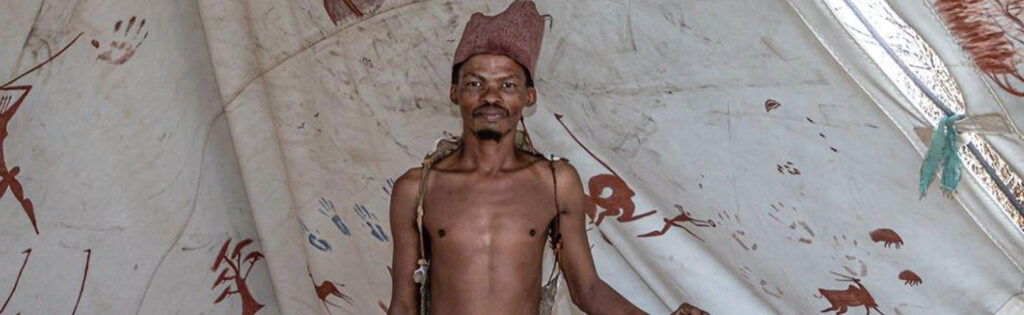
South Africa recognises 11 official languages and its national motto, “!ke e: /xarra //ke”, is written in the extinct ǀXam language, meaning “Diverse people unite.” It is powerful that the nation’s very motto comes from Khoisan heritage. Yet Khoisan languages, despite forming an integral part of pre-colonial Southern Africa, were not included among the official languages. This also highlights a paradox: the language of unity is itself no longer spoken widely.
For years, many Khoisan individuals were unable to correctly spell their names on official documents because the system did not accommodate their unique click characters and orthography. Names had to be altered or simplified, stripping away identity at the most personal level.
However, in a landmark development in March 2026, South Africa’s Department of Home Affairs updated its identity document systems so that traditional Khoi-San names, including special characters used in click languages can now be officially recognised on birth certificates, Smart IDs, and passports. For the first time in history, !Khūboab Oedasoua Lawrence, a young Khoisan man received a Smart ID reflecting his full cultural name with click characters properly displayed. By updating the ID system to include these characters, South Africa has done more than modify software; it has acknowledged dignity, language, and cultural legitimacy.
A Broader Reflection: Who Gets Left Behind?
The story of the Khoisan invites a broader question: Are the original cultures and histories of many African people being left behind in modern nation-states?
Language is often the first casualty of marginalisation. Yet across Africa, we also see inspiring examples of preservation:
- Amharic remains a powerful national language in Ethiopia, written in its unique Ge’ez script, a script that has survived for centuries and still defines identity in official, religious, and literary life.
- Tigrinya, spoken in Eritrea and northern Ethiopia, also uses the Ge’ez script and maintains strong literary and cultural traditions, particularly through oral poetry and coffee ceremony culture.
- Twi, widely spoken in Ghana, continues to thrive in media, music, church life, and digital spaces, proving that indigenous languages can adapt and remain dominant in modern contexts.
These languages demonstrate that preservation is possible when there is institutional support, cultural pride, and intergenerational transmission.
But what about smaller ethnic groups across Africa whose scripts are not digitised, whose names are not recognised by official systems, and whose oral histories are undocumented?
South Africa’s recognition of Khoisan characters sets a precedent: governments can adapt systems to honour indigenous identity rather than forcing identity to adapt to systems.
Celebrating a People Once Left Behind
Sadly, the Khoisan population stands at approximately 100,000 across Southern Africa, primarily in Botswana, Namibia, and South Africa. In South Africa, estimates suggest around 10,000-15,000, though exact figures vary due to fluid identities and undercounting. Challenges like urbanization and climate change threaten their way of life, but growing awareness and legal protections offer hope.
Celebrating the Khoisan today means more than admiration. It means telling their stories accurately. It means preserving endangered languages. It means supporting cultural revival efforts. It means acknowledging that being “first” does not mean being forgotten. The Khoisan are not relics of the past; they are living communities reclaiming space in the present. In honoring them, Southern Africa honors its oldest roots, and the Rainbow Nation becomes a little more complete.
Your culture passport awaits.

She Speaks Africa uses culture and creativity to connect brands and governments with pan-African and diasporan audiences through authentic storytelling.